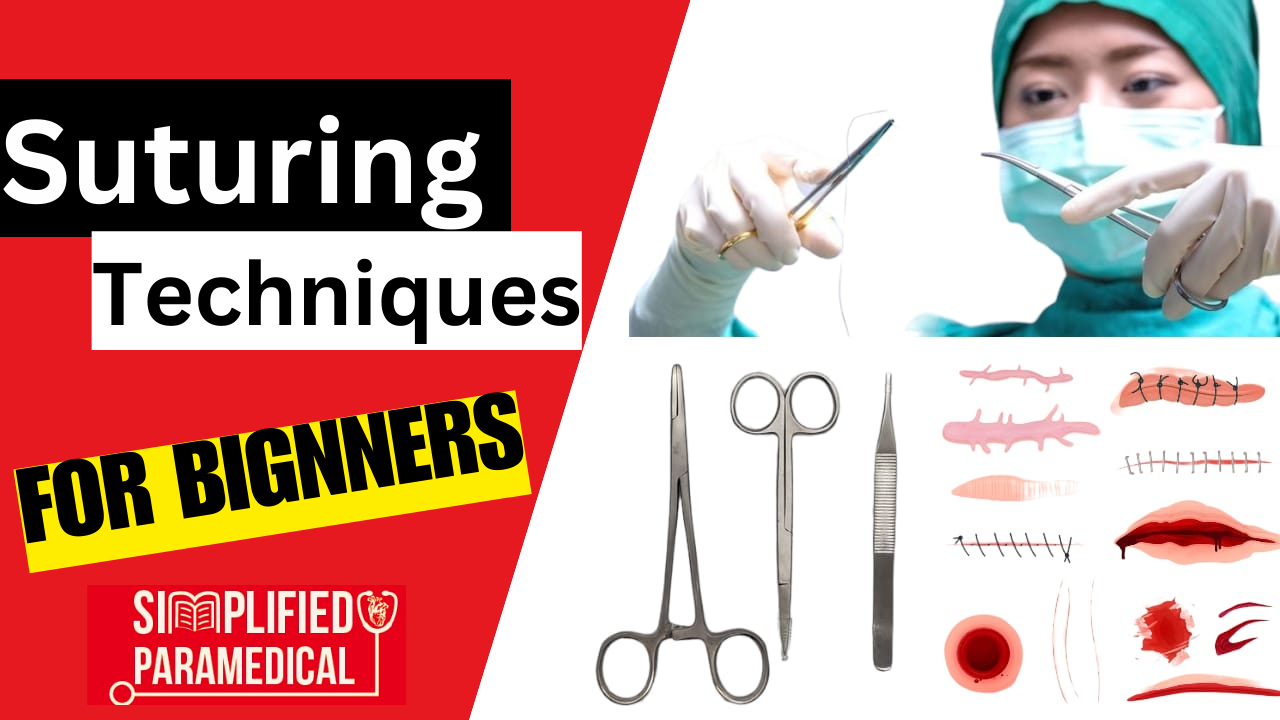
Suturing is a fundamental skill for surgical professionals· It is critical for ensuring proper tissue approximation and facilitating healing· Various suturing techniques are employed based on the type of tissue, location of the wound, and desired cosmetic outcome·
Understanding Sutures
Sutures:
Materials: Used to close wounds by stitching edges together·
Types:
- Absorbable: These sutures dissolve in the body over time and are typically used for internal tissues where removal is not feasible·
- Non-absorbable: These sutures do not dissolve and are used for external tissues or situations where long-term support is needed· They require removal after the wound has healed·
Shapes and Sizes: Sutures come in various shapes, sizes, and materials· They are chosen based on the type of tissue and wound conditions· For instance, finer sutures are used for delicate tissues like those in the face, while stronger, thicker sutures might be used for more robust tissues like muscle or fascia·
Needles:
- Function: Needles are used to carry sutures through tissue to close wounds·
- Variety: They vary in shape and size· Curved needles are commonly used for deeper or more intricate areas, while straight needles might be used for surface work·
- Qualities: Needles must possess strength, ductility, sharpness, and stability· These qualities ensure the needle can pass through tissue efficiently with minimal trauma·
- Performance: Effective needles pass through tissue smoothly, causing minimal damage and ensuring precise suture placement·
Your First Suture
Initial Experience:
Placing your first suture can be daunting and exhilarating· The process might be time-consuming initially (e·g·, taking 60 minutes for the first 5 sutures)·
New surgeons often feel pressure to be quick, but it’s crucial to focus on technique over speed·
Focus on Skill, Not Speed:
Do not worry about time; suturing is not a race· It is more important to be precise and accurate·
First, focus on becoming skilled; speed will come with practice and experience·
Mastering Efficiency:
The best surgeons are fast because they have mastered economy of motion, not because they rush· They use minimal movements, making each action count·
It is more efficient to place a suture correctly the first time than to redo it multiple times· Redoing a suture can damage tissue and extend the surgery time·
Essential Parts of Placing a Suture
Placing a suture involves two critical steps: driving the needle through the tissue and tying the knot·
Driving the Needle:
Ensure the needle passes smoothly and precisely through the tissue· This involves proper needle handling, angle of entry, and smooth motion to minimize tissue trauma·
Tying the Knot:
Secure the suture with a reliable knot to maintain tissue approximation· A good knot holds the suture in place, ensuring the wound edges stay together during healing·
A. Driving the Needle
Step 1: Loading the Needle
Secure in Holder:
Grasp the needle at the distal third of the needle holder’s jaws to ensure maximum control and stability·
Ensure a firm grip to avoid slippage during suturing·
Alternative Loading:
A scrub nurse or assistant can load the needle·
Passing Technique:
Hold the needle holder by the shanks with the needle facing away to avoid accidental injury·
The surgeon receives the needle holder with an open palm to ensure a secure handover·
Step 2: Positioning for Needle Entry
Wrist Pronation:
Pronate the wrist so that the needle enters the tissue perpendicularly· This angle ensures a straight, controlled entry·
Optionally, remove the thumb from the ring of the needle holder to avoid strain and improve maneuverability·
Edge Eversion:
Use forceps or a skin hook to evert (lift) the skin edge, making it easier to insert the needle at the correct angle and ensuring a clean entry·
Step 3: Driving the Needle
Hand Supination:
Drive the needle by supinating (rotating) the hand, following the natural arc of the needle· No forward pushing motion is required; the hand’s rotation guides the needle through the tissue·
Follow the needle’s arc for a smooth passage through the tissue·
Minimize Resistance:
Ensure the needle moves smoothly with minimal force· If excessive force is needed, reassess the angle and technique·
Aim for an even bite, meaning the distance from the needle’s entry point to the tissue edge should be equal to the distance from the exit point to the tissue edge· This creates a symmetrical, secure stitch·
Step 4: Needle Retrieval
Retrieve with Forceps:
Use forceps to retrieve the needle, avoiding the delicate tip area to prevent bending or dulling·
Reload the needle holder for the next suture pass if needed, maintaining a consistent and efficient workflow·
B. Steps to Tie a Knot
Initial Preparation:
Grip: Hold the long end of the thread with your non-dominant hand between the index finger and thumb for stability and control·
Length: Leave 8-13 cm of thread between your fingers and the skin edge to allow for comfortable knot tying·
Creating the First Knot:
Looping: Wrap the thread 2-3 times over the needle holder in a clockwise direction to form the first loop·
Grasping: Use the needle holder to grasp the short end of the thread securely·
Pulling: Pull the short end across to the opposite side of the wound, forming a square knot·
Second Throw:
Opposite Looping: Loop the long end of the thread under the needle holder in an anticlockwise direction·
Grasping and Pulling: Grasp the short end again and pull it back to the original side while pulling the long end in the opposite direction, ensuring a surgeon’s knot·
Additional Throws:
Alternating Directions: Continue adding throws, alternating the direction of each throw and pull to lock the knot securely·
Number of Throws:
Nylon: 4 throws·
Monocryl/Vicryl: 5-6 throws·
PDS II: 7 throws·
Prolene: Up to 9 throws due to its low friction coefficient·
Cutting the Suture:
Technique: Place one scissor blade on the knot, angle the other at 45 degrees, and cut precisely to avoid cutting the knot·
Suture Ends: Cut the suture ends short to minimize foreign material, leaving enough length for easy removal·
Cut Excess Thread: Leave 3-5 mm of suture tail to facilitate knot security and later removal·
Types and Classification of Suturing Techniques
Basic Suturing Techniques
Simple Interrupted Sutures:
Application: Commonly used for general skin closure·
Technique:
Each stitch is tied and cut individually, allowing for precise tension adjustment·
Provides accurate wound edge approximation, essential for healing·
Particularly useful for irregular or jagged lacerations where individual control is necessary·
Permits meticulous alignment of wound edges, ensuring optimal healing·
Continuous Sutures (Running Sutures):
Application: Suitable for long, straight wounds·
Technique:
A single suture line is run along the wound without tying and cutting between each stitch·
Faster to place than interrupted sutures, saving time during surgery·
Distributes tension evenly along the wound, which can aid in healing·
If one part of the suture line fails, it can compromise the entire wound closure, so careful technique is crucial·
Vertical Mattress Sutures:
Application: Used when there is a need to evert (turn outward) the skin edges·
Technique:
The suture passes through the skin at four points, creating a vertical loop·
Provides excellent eversion of skin edges, which is important for preventing scar depression·
Particularly useful in areas with high tension or thick skin, such as the back or scalp·
Horizontal Mattress Sutures:
Application: Ideal for areas requiring high tension closure, such as joints·
Technique:
The suture passes through the skin at four points, creating a horizontal loop·
Provides good wound edge eversion and strong closure·
Suitable for thick skin areas like the palms and soles, where additional support is needed·
Advanced Suturing Techniques
Subcuticular (Intradermal) Sutures:
Application: Preferred for cosmetic closures·
Technique:
The suture is placed within the dermis, running parallel to the wound edges·
Avoids suture marks on the skin surface, providing a more aesthetically pleasing result·
Commonly used in facial and breast surgery for a smooth appearance·
Locking Sutures:
Application: Provides additional security for long, linear wounds·
Technique:
Each stitch locks into the previous one, creating a secure closure that prevents suture slippage·
Useful in areas with high tension or movement, such as the abdomen·
Figure-of-Eight Sutures:
Application: Used for areas requiring secure closure with high tension, such as tendon repairs·
Technique:
The suture passes through the tissue in a figure-of-eight pattern, providing strong and secure closure·
Effective for areas under significant mechanical stress·
Purse-String Sutures:
Application: Commonly used for circular wounds, such as those resulting from biopsies·
Technique:
A continuous suture is placed around the circumference of the wound·
When tightened, it draws the edges of the wound together·
Often used in procedures like stoma closure·
Key Considerations
- Square Knots: Ensure knots are square to prevent slippage and maintain security·
- Consistent Tension: Apply even tension to each throw to maintain knot integrity·
- Material-Specific Adjustments: Adjust the number of throws based on the suture material’s properties (tension, slipperiness)·
- Careful Cutting: Use precise techniques to avoid cutting through the knot and ensure easy removal·
- Practice: Regular practice is essential for mastering knot tying techniques, improving speed, and ensuring precision·
Conclusion
Mastering suturing techniques involves understanding the appropriate materials, proper handling of needles, and precise knot tying· Each technique has its specific applications, advantages, and considerations· Regular practice and adherence to these detailed steps will enhance your suturing skills and ensure optimal wound healing· Always aim for precision and adaptability in real-world scenarios to achieve the best surgical outcomes·